Nº 17 · 29 Jul 2026
Confluence filters: 0 of 5 crypto stacks beat random
- Stacks written down before testing
- 10
- Worst filter
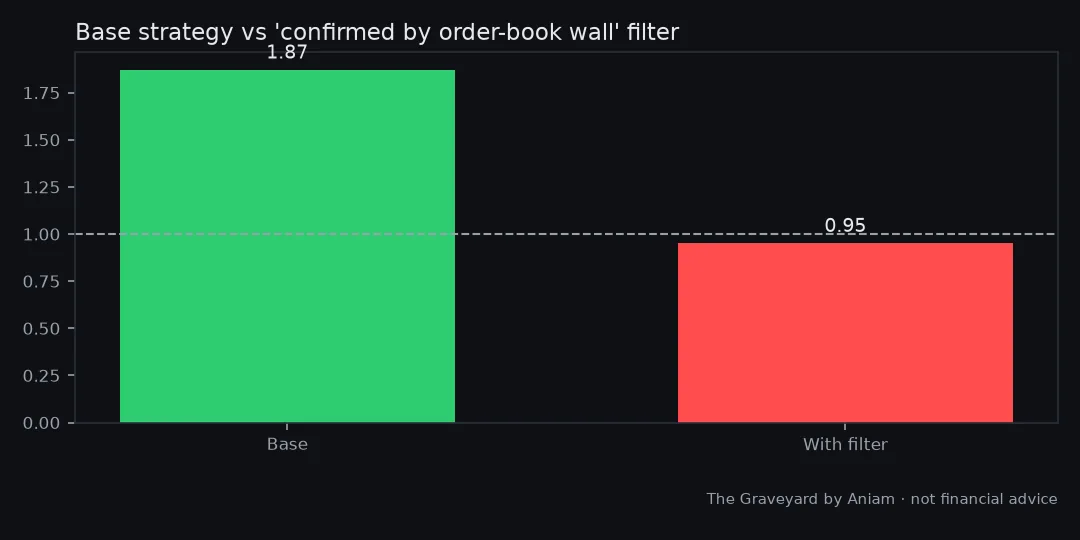
- PF 1.87 → 0.95
- Trades that filter kept
- 63%
None of the crypto stacks beat a random filter.
Read the autopsyclaim · method · every number · the raw chart
Source: Confluence trading, widespread
One filter cut profit factor from 1.87 to 0.95. It threw out the good trades.
On small samples, most confluence claims can't be checked at all.
This verdict is about the strategy as published, not about the person who shared it.
The claim
Here’s what the strategy promises, in its own terms.
A signal too weak to trade alone still helps as a filter on another strategy.
How we tested it
Same six checks as everything else here: random entries, coin flips, a look-ahead audit, unseen years, double costs and a luck check. How we test →
What we found
Ten stacks were written down before testing (5 gold, 5 crypto). On crypto, 0 of 5 beat a control that used a random secondary signal with the same firing rate. Worse, one filter cut the base strategy's profit factor from 1.87 to 0.95 while keeping 63% of trades: it removed the good trades. The trap: at a 4:1 reward-to-risk and 18% win rate, a random filter reaches profit factor 2.3-5.1 on 50 trades at the 95th percentile, so most confluence claims on small samples cannot be falsified at all.
The numbers
The headline numbers from our test.
| Stacks preregistered | 10 |
|---|---|
| Crypto stacks beating random | 0 |
| Filter effect PF | 1.87 -> 0.95 |
| Trades kept | 63% |
| Random filter PF 95th-pct n=50 | 2.3-5.1 |
- Profit factor: money won divided by money lost. Below 1.0 loses money. Around 1.0 is break-even.
- R-multiple: profit or loss measured in units of the amount risked per trade. +1R means you made what you risked.
- vs random: how the strategy did against the same trades with random entries.
You’re on the list.
Your first issue arrives with the next weekly send. Until then, the graveyard is open.